Are We Ready to Hand Over the Pager? The Mechanical vs. Judgment Gap in AI-Driven SRE
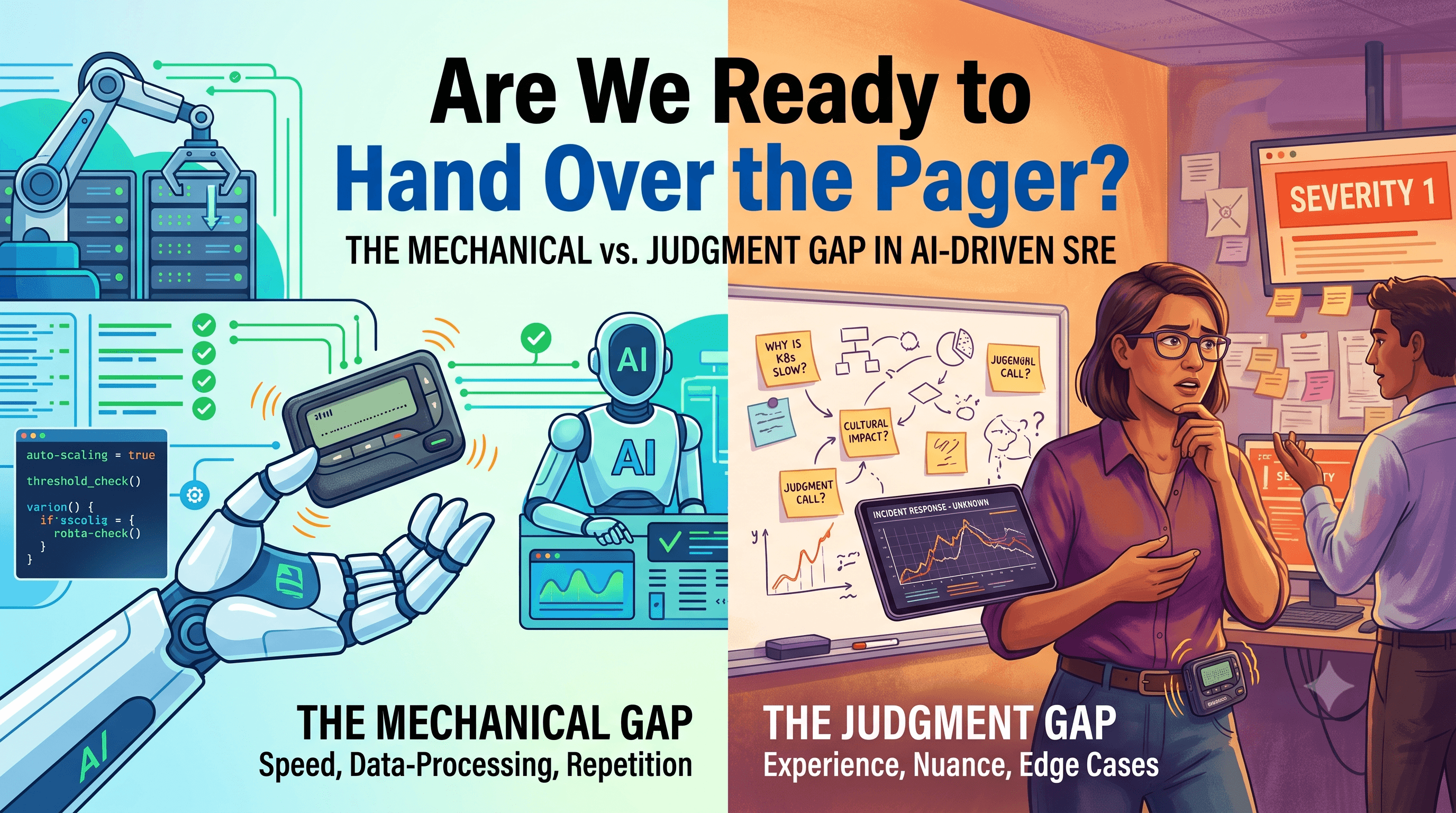
I’ve spent the last few weeks intimately familiar with the absolute worst part of systems engineering: the fear of the 3:00 AM PagerDuty call.
If you've ever been on an on-call rotation, you know the exact physical sensation of being woken up at 3:00 AM by a piercing phone alert. Your heart rate spikes, your adrenaline surges, and you sit in front of a glowing monitor in a dark room, desperately trying to figure out why your system is quietly setting itself on fire.
According to Catchpoint's 2025 SRE Report, the industry's closest thing to a State of the Union address, except everyone in the room has a Slack notification going off, nearly 70% of SREs say on-call stress has directly driven burnout and attrition. It's not just a morale problem anymore; it's an active reliability risk. Tired engineers make worse decisions, and worse decisions at 3 AM are how outages become incidents, and incidents become incident reviews, and incident reviews become the reason nobody wants to touch the deploy button on a Friday.
So when a wave of startups launched in 2026 promising "Autonomous AI SREs" capable of "taking over the pager," my immediate, skeptical engineering instinct kicked in.
The phrase "holding the pager" is intentionally loaded. The pager isn't just about the labor of writing a fix; it's about accountability. It represents being the human who is legally and professionally responsible when the system breaks.
Can we really hand that over to an AI agent?
To answer that, we have to look past the marketing hype and get into the actual mechanical-versus-judgment gap in modern systems engineering.
The Messy Evolution of Observability
It is tempting to look at the history of software operations and draw a clean, linear timeline:
Legacy AIOps (2017-2022) ──► AI-Assisted SRE (2022-2024) ──►Autonomous Agents (2024+)
In reality, the history is a lot messier than a roadmap slide would have you believe.
Back in the AIOps era, platforms were already attempting complex topology reasoning, dependency graph mapping, and root-cause suggestions. Conversely, many of the autonomous AI agents being marketed today are not some magical new breed of sentient software; they are simply Large Language Models (LLMs) wrapped in basic tool-calling workflows and execution engines.
The core operational problems haven't changed. What's changed is our interface for wrestling with system complexity.
Legacy AIOps failed because its alerts behaved like a hypersensitive car alarm parked on a busy street. It screams every time a heavy truck rumbles by. Because it triggers constantly for no valid reason, everyone in the neighborhood learns to tune it out completely, right up until the one time someone's actually breaking into the car. This is alert fatigue, and per that same Catchpoint report, it's serious enough that 44% of organizations have experienced outages tied directly to alerts that got ignored or suppressed.
Modern agentic workflows try to fix this by moving raw telemetry into conversational planning loops instead of just screaming louder.
The Metric That Matters: Why Diagnosis Is 90% of MTTR
In SRE, the metric that determines whether your business survives a major outage is MTTR (Mean Time to Recovery). High-impact outages routinely cost organizations millions of dollars, with the worst incidents approaching $2 million per hour(according to the New Relic Observability Forecast 2025, via Runframe).
But if you analyze any critical incident, you will find a fundamental truth: most of MTTR is spent on diagnosis, not the fix
If a database connection pool gets exhausted during a Cloud Run scaling spike, actually executing the mitigation (like adjusting connection limits or restarting a service) takes less than two minutes. But finding out why the pool exhausted while you're half-asleep and squinting at Grafana? That's the part that eats your night.
This diagnostic gap is exactly where agents earn their keep, not as oracles, but as very fast, very well-read assistants:
Instead of acting as a black-box oracle that executes blind fixes, a well-built agent can gather context, correlate recent git commits, and hand you a ranked list of plausible root causes with confidence scores attached. That's not replacing human judgment. That's someone else doing the reading so you can get straight to deciding.
First Principles vs. Statistical Patterns
A common critique is that AI is weakest when facing novel failure modes — the chaotic, unprecedented stuff that's never happened in your system before.
Fair. But let's be honest: humans are also terrible at novel failures. Nobody has natural, muscle memory for an outage that has literally never happened before in the history of the company.
The real difference lies in how we attempt to solve the unprecedented:
AI reasons from statistical patterns. An LLM agent scans its training data and your historical logs, trying to match the current anomaly against past probability. If the failure really is unique, there's no pattern to match, and the agent doesn't say "I don't know"; it says something fluent, confident, and completely wrong. This is the scariest failure mode in the entire stack, because it sounds like competence.
Humans reason from first principles. A senior SRE facing something genuinely new drops the manual, steps back, and constructs a mental model based on first-principles physics and system architecture. They ask: "If the database write queue is full, but network I/O is zero, what are the physical resource constraints that could block a TCP socket?"
Today's AI systems are remarkably good at pattern matching, but they still struggle to consistently reproduce the systems reasoning experienced engineers rely on during genuinely novel failures.
The Decision Bottleneck: Context Is Easy, Deciding Is Hard
We used to argue AI can't handle production because it lacks business context; it doesn't know which customer actually matters.
That argument is losing ground fast. In 2026, with modern API integrations, we can easily feed our agents metadata from our CRMs, Salesforce, Stripe revenue dashboards, and incident priority policies. The agent can easily "know" that: "The customer currently experiencing 500 errors is our primary enterprise account, contributing KSh 450 million in annual recurring revenue."
Knowing isn't the hard part anymore. Deciding is.
When an incident strikes, every mitigation option has a major downside. If your primary payment gateway is failing, do you route traffic to a secondary gateway that has higher transaction fees but is currently stable? Do you initiate an immediate database rollback, knowing that because the database schema was modified, the rollback will cause permanent data corruption for active users?
Weighing these trade-offs, accepting the business risk, and executing a high-stakes, irreversible action is where human judgment remains non-negotiable
The Upward Shift of Accountability: Who Built the System?
This is where the whole SRE and platform-engineering paradigm actually changes.
We like to say: "We can't hand over the pager because the AI doesn't get fired when things go wrong." While true, this oversimplifies the concept of accountability.
If an autonomous AI agent, something like Sherlocks.ai, one of a handful of vendors selling into exactly this space, is granted write access to your GKE clusters, executes an automated rollback mid-incident, and corrupts your production database... who's actually accountable?
It's not the AI. It's also not the on-call engineer who was asleep while the agent ran the show.
The accountability moves upward, to whoever designed the system in the first place.
As we move toward autonomous operations, your job is leveling up whether you asked for it or not. You're no longer just the person running manual commands; you're the person who built the guardrails, scoped the least-privilege IAM policies, and decided exactly what the AI is and isn't allowed to touch. If it goes wrong, that design is the postmortem.
Conclusion: The Future of the Pager
"Are we ready to hand over the pager?" is the wrong question, because it assumes a clean binary handoff that isn't actually happening.
We're already handing over the mechanical, high-toil, time-consuming diagnostic grind. Tools like Sherlocks.ai represent this new generation of AI-assisted incident investigation by helping engineers connect logs, alerts, deployments, metrics, and operational context during an investigation, reducing the manual effort required to understand what happened.
But the judgment layer, the first-principles reasoning, and the high-stakes trade-off decisions remain ours.
In five years, "holding the pager" won't mean waking up at 3 AM to manually tail logs and run raw SSH commands. It will mean being the architect who is accountable for the safety, policies, and design of the automated systems that run our world.
The pager isn't disappearing. It's changing hands from the engineer who responds to failures to the engineer who designs the systems that decide how failures are handled.
What do you think? Would you let an AI recommend, or even execute a production rollback in your cluster, or would you keep a human firmly in the approval loop? Let's chat on Linkedin