Test-Driven Development: Write Better Code by Writing Tests First
What is TDD Really?
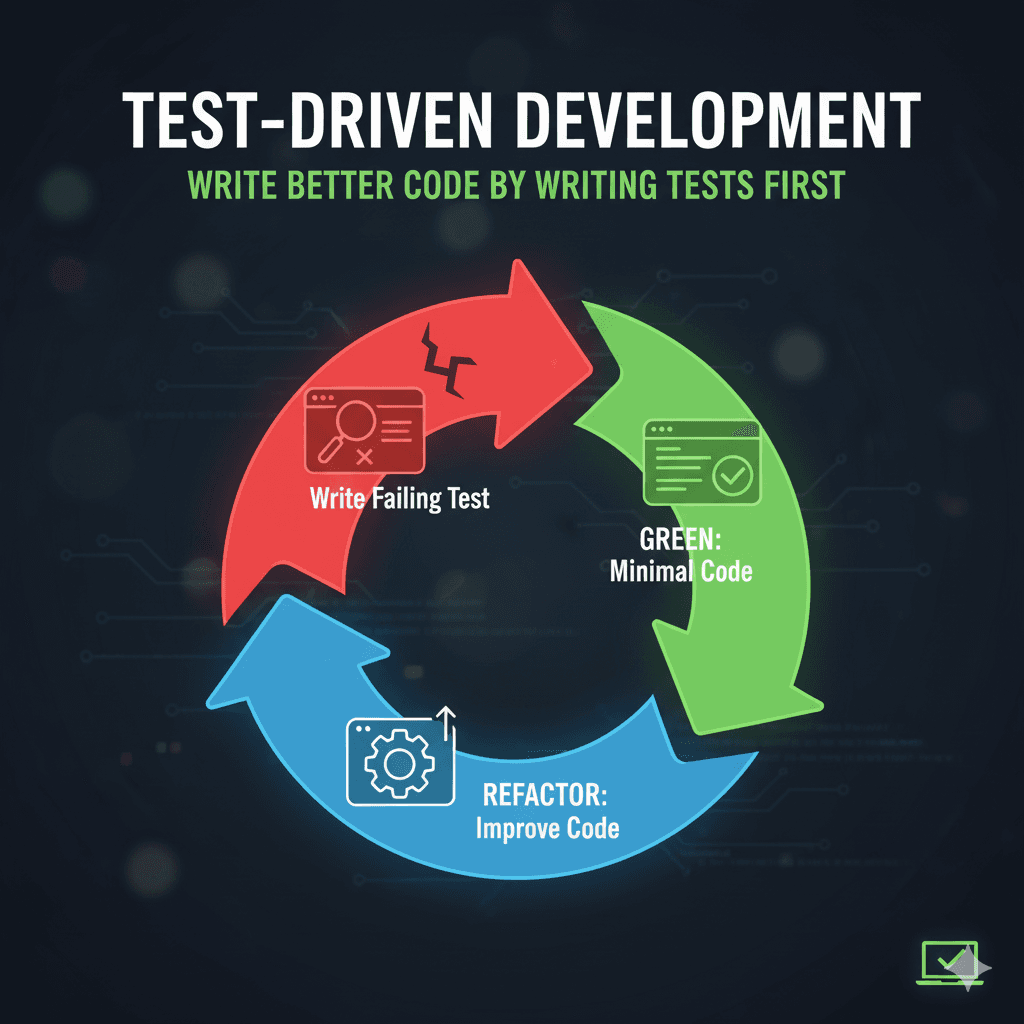
Test-Driven Development (TDD) is a coding approach where you write tests before writing the actual code. It sounds backward, but it transforms how you design and build software.
The cycle is simple:
RED - Write a failing test
GREEN - Write minimal code to pass
REFACTOR - Improve code without breaking tests

Why Bother with TDD?
You'll Write Code That Actually Works
How many times have you "finished" coding, only to find hidden bugs later? TDD ensures every piece of functionality is verified the moment it's written.
It Prevents Over-Engineering
When you write tests first, you only build what you actually need. No more "what if" features that complicate your code.
Your Tests Actually Test Something
Ever written tests that always pass? With TDD, you see tests fail first, proving they can catch real problems.

Let's Build Twitter's Vowel Remover
Twitter famously removed vowels to fit messages in 140 characters. "Twitter" becomes "twttr". Let's build this using TDD.
Step 1: RED - Write a Failing Test
# test_twttr.py
from twttr import shorten

def test_remove_vowels_from_twitter():
    result = shorten("twitter")
    assert result == "twttr"
Run this test (pytest test_twttr.py). It fails because shorten() it doesn't exist yet.

Why this matters: The failure proves our test works and can detect problems.
Step 2: GREEN - Write Minimal Code to Pass
# twttr.py
def shorten(word):
    return "twttr"  # The simplest thing that could work(Cheating)
Run the test again. It passes!

Why we "cheat": This keeps us focused on one requirement at a time.
Step 3: Add Another Test - Back to RED
def test_remove_vowels_from_hello():
    result = shorten("hello")
    assert result == "hll"
Run tests again. First test passes, second fails. Perfect progression.
Step 4: Write Real Logic - GREEN
def shorten(word):
    result = ""
    for char in word:
        if char.lower() not in "aeiou":
            result += char
    return result
Both tests pass! We now have working logic.
Step 5: Add Edge Cases
def test_empty_string():
    assert shorten("") == ""

def test_all_vowels():
    assert shorten("aeiou") == ""

def test_mixed_case():
    assert shorten("Hello World") == "Hll Wrld"
All tests pass with our current implementation.
Step 6: REFACTOR
def shorten(word):
    vowels = "aeiouAEIOU"
    return "".join(char for char in word if char not in vowels)
Run tests again - still green! We improved the code without breaking anything.

Common TDD Objections (And Why They're Wrong)
"It Slows Me Down"
Short-term: yes. Long-term: you save hours of debugging and rewriting.
"My Code Changes Too Much for Tests"
If your code changes frequently, tests are even more valuable. They catch breaks immediately.
"I Don't Know What to Test"
Start with the happy path, then add edge cases:
Normal input
Empty input
Boundary cases
Error conditions
When TDD Shines
New features: Design through tests
Bug fixes: Reproduce the bug with a test first
Legacy code: Add tests before modifying
Learning: Understand requirements before implementing
Your TDD Cheat Sheet
Think: What's the smallest behaviour I need?
Test: Write a test for that behaviour
Run: Watch it fail (RED)
Code: Write minimal code to pass (GREEN)
Clean: Improve code without breaking tests (REFACTOR)
Repeat: Choose the next smallest behaviour

Bottom Line
TDD isn't about religiously following rules. It's about building confidence in your code, one verified piece at a time.
The next time you start coding, try writing the test first. That red-to-green transition might just become your new addiction.